Salford City Council’s debut all-electric refuse truck is smashing range expectations, winning over drivers, and proving electric RCVs are ready for frontline municipal operations. LAPV reports.
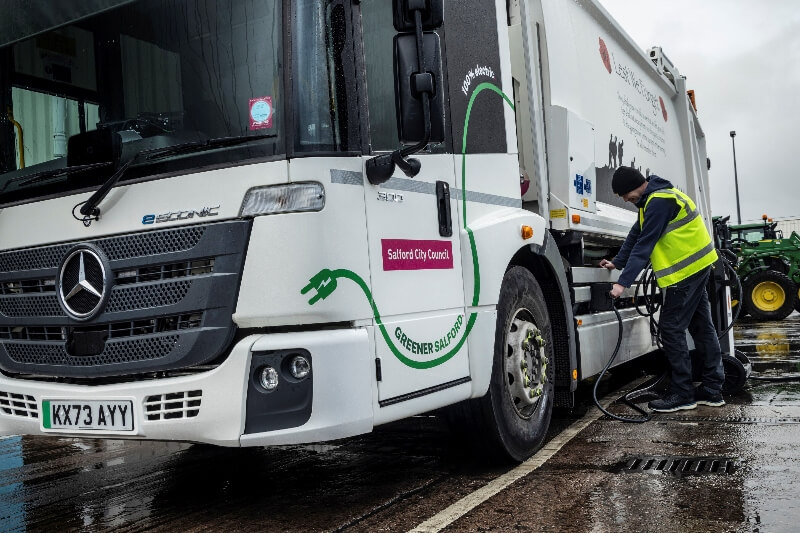

Salford City Council has taken a major step toward its 2038 net-zero ambition with the introduction of its first all-electric refuse collection vehicle (RCV) – and early results suggest the truck is reshaping expectations of what an electric municipal fleet can deliver.
The 27-tonne all-electric Mercedes-Benz eEconic is among the first vehicles of its kind to enter service with a UK council. Designed for heavy, stop-start urban work, it pairs zero-emission operation with a payload close to that of the diesel Econic. Crucially for local authorities, it also offers a class-leading operational range of at least 150 km in real refuse conditions – a performance that helped Mercedes-Benz Trucks UK secure Innovator of the Year at the 2025 Fleet Vision International Awards.
Salford selected the eEconic following an extensive hands-on evaluation, trialling it across full daily rounds and directly comparing it to other electric models. The verdict was decisive. The eEconic not only completed every route on a single charge but consistently returned to the depot with 40–60% battery capacity in reserve.
Alan Fitzsimons, Transport Manager at Salford City Council, says the difference was clear from day one: ‘The Mercedes-Benz eEconic is leaps and bounds above the rest. During our demonstration period, it completed every route with battery range to spare, while competitors struggled to finish on a single charge. It is 100% electric, and the range and regenerative braking are excellent. It has surpassed all our expectations and we’re proud to lead the way in sustainable waste collection for Salford residents.’
At 27 tonnes when fully loaded – only a tonne more than the council’s typical 26-tonne diesel equivalents – the eEconic integrates smoothly into Salford’s 36-truck refuse fleet. It handles over 1,200 bins per day, matching the operational tempo expected of frontline municipal assets while eliminating tailpipe emissions. Fitzsimons says the council’s procurement approach has shifted in recent years: ‘For cost reasons, we previously bought cheaper trucks, but experience has shown that quality and reliability matter. We have been gradually returning our fleet to Mercedes-Benz, adding around one new vehicle per year to serve Salford’s growing population.’
One of the most powerful endorsements has come from behind the wheel. Driver acceptance is critical for any new fleet investment, and the eEconic has proved an instant hit.
Anthony Kearns, HGV driver and trainer, admits he initially worried about whether the electric RCV could complete the city’s longest routes. That concern quickly disappeared. ‘My biggest worry was whether it would complete the route, but on my longest day, when I travel 60 miles and take three loads totalling 30 tonnes, it still has 36% battery left after seven hours,’ he said. ‘It’s second to none compared to other vehicles we’ve tried, plus other drivers keep telling me, “No wonder you like driving this – it’s like a Rolls Royce of bin trucks.”’
Comfort and drivability have also been standout features. As Kearns explains, ‘It’s much quieter than a diesel, cooler in summer, smoother to drive, and a real pleasure for city streets. The pre-heat function and regenerative braking make a real difference, ensuring the battery lasts while keeping the cab comfortable.’ Pull out quote: ‘Other drivers keep telling me, “No wonder you like driving this – it’s like a Rolls Royce of bin trucks.”’
In addition to its operational performance, the eEconic has been delivered with a special ‘Lest We Forget’ livery for Armed Forces Week, reflecting the council’s commitment to honouring military service while embracing new, cleaner technologies. For Daimler Truck UK, the Salford deployment shows how electric refuse trucks are moving from pilot projects to reliable daily workhorses. Managing Director Heiko Selzam says: ‘The positive feedback from Salford City Council shows that all-electric trucks can deliver more than sustainability benefits. The eEconic provides excellent range, quieter operation, and better working conditions for drivers, proving electric refuse trucks are ready for real-world urban use.’
Salford’s transition strategy is based on natural fleet replacement wherever possible. Operational life for the council’s refuse vehicles has already extended from seven to 10 years, reducing whole-life costs while providing a clear pathway for lower-carbon upgrades.
As more councils assess their routes, duty cycles and charging constraints, Salford’s early success story provides strong evidence that electric RCVs can deliver dependable range, high productivity and improved driver experience – all without compromising day-to-day service delivery.
With its first eEconic now in service and exceeding expectations, the city is signalling that the next generation of municipal fleets is already rolling through its streets.
This article was originally published in the Winter 2025 issue of LAPV. Sign up here to receive your free copy of future issues.