















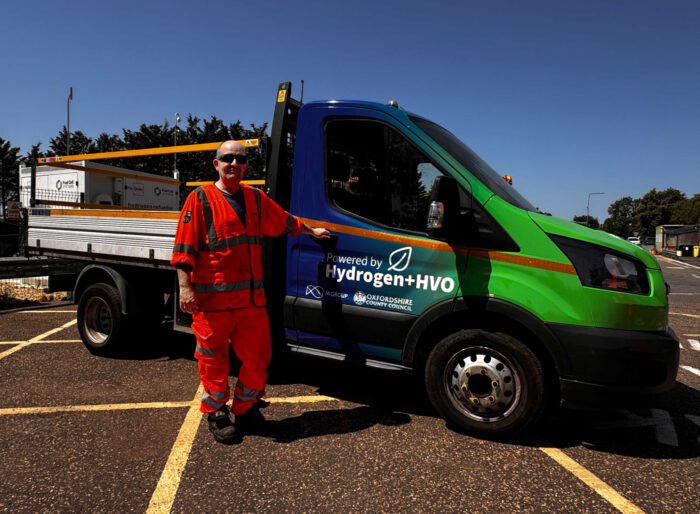
Oxfordshire County Council (OCC) is putting hydrogen power to the test on its roads, retrofitting a used vehicle with a dual-fuel hydrogen/HVO system in partnership with ULEMCo as part of a two-year trial. The project, delivered through M Group’s dedicated hydrogen vehicle investment fund, forms part of a wider push to decarbonise the council’s fleet ahead of its 2030 net zero target.
From sourcing specialist hydrogen tanks with lead times of up to six months, to building on-site refuelling infrastructure through the HYER research project, the trial has thrown up practical lessons for authorities considering a similar route. Here, we speak to the team behind the project about the technical and logistical hurdles involved, how costs compare to diesel alternatives, the training and safety measures put in place for crews, and what the council’s longer-term roadmap for fleet decarbonisation looks like – and whether it’s a model other authorities could follow.
What were the main practical and technical challenges in retrofitting the truck, and what did the process with ULEMCo involve?
There were two main logistical challenges for Oxfordshire County Council (OCC): sourcing the specialist hydrogen tanks, accurately sizing them for the vehicle’s duty cycle, and identifying a suitable vehicle for the trial.
The hydrogen tanks are manufactured in Canada and can have lead times of up to six months if the required size is not already in stock. Estimating daily mileage was important to ensure the tanks provided sufficient range without adding excessive weight, as larger tanks reduce payload capacity and could affect operational productivity.
As this was a two-year trial, M Group chose to retrofit a suitable used vehicle rather than purchase a new vehicle. The vehicle was sourced from within the business and supplied to ULEMCo for conversion. The retrofit process itself was relatively straightforward, with ULEMCo installing the dual-fuel hydrogen/HVO system and later providing operator training and support.
How does the total cost of ownership compare with a standard diesel equivalent, including retrofit costs, running costs and any funding support?
A full comparison is still being assessed because operational data is being gathered during the trial. Retrofit costs vary depending on vehicle specification and hydrogen tank capacity, but the project demonstrated that converting a used vehicle can provide a more cost-effective route into hydrogen than purchasing a new hydrogen-powered vehicle.
The retrofit and vehicle costs were funded through M Group’s dedicated hydrogen vehicle investment fund, with the conversion costing approximately £30,000-£40,000. Running costs are currently difficult to quantify because, through the HYER project, the electrolyser installation and first year’s hydrogen production were fully funded. Electricity consumption data is now being collected and will help determine future hydrogen production costs and carbon savings.
The ULEMCo system itself has relatively low maintenance requirements, with only routine monitoring and annual checks required.
What refuelling infrastructure was needed, and how easily could this be scaled up for a larger hydrogen fleet?
The vehicle is fuelled using hydrogen produced on-site via an electrolyser installed at the depot through the separate HYER research project. This infrastructure was necessary because there was no suitable local hydrogen supply available.
The current electrolyser is sized to support the initial HYER vehicles and a small number of additional dual-fuel vehicles, but the system was designed with expansion in mind. Additional hydrogen storage can be added, and the modular design allows production capacity to be increased as demand grows. This means the infrastructure could be scaled relatively easily to support a larger hydrogen fleet in the future without requiring a complete redesign.
What training and safety measures were put in place for crews, and were there any unexpected lessons learned?
A comprehensive programme of risk assessments, safety reviews and training was completed before the vehicle entered service. Fuel Cell Systems Ltd (FCSL) provided training on hydrogen safety, operation of the electrolyser and refuelling equipment, while ULEMCo delivered vehicle-specific training covering refuelling, operation and emergency procedures.
Safety measures included updated risk assessments, signage, control measures, physical protection around the refuelling equipment, and compliance checks. The vehicle also received a Vehicle Special Order (VSO) approval from the Vehicle Certification Agency (VCA). The electrolyser and vehicle both incorporate multiple fail-safe systems, pressure controls and safety mechanisms.
One of the key lessons learned was that initial concerns among crews about hydrogen safety reduced significantly once they understood the technology and safeguards in place. The project team has found that hydrogen systems are highly controlled and may be perceived as safer than many conventional fuel systems. Longer-term operational data will continue to be collected throughout the trial to identify further lessons and performance insights.
What does the council’s longer-term roadmap look like for decarbonising its wider fleet, and could this approach be replicated by other authorities?
OCC’s longer-term road map for decarbonising its wider fleet is a phased, evidence-led transition to zero tailpipe emission vehicles, aligned to the council’s ambition to achieve net zero carbon emissions from its own operations by 2030. The approach recognises that vehicle replacement alone is not enough; it must be supported by charging infrastructure, reliable fleet data, financial planning, governance and service-by-service assessment of operational need.
In the short term, OCC is making best use of its existing estate by installing EV chargers where capacity allows, progressing targeted grid upgrades and supporting home charging where operationally appropriate. Over the medium to longer term, the roadmap moves towards a planned network of strategically located charging capacity, including the potential use of dedicated EV charging hubs to address geographic gaps, support fleet growth and improve operational resilience.
The road map is underpinned by better fleet intelligence. A future telematics, vehicle camera data along with the Fleet Management System will provide a stronger evidence base on mileage, utilisation, journey patterns, idling, charging behaviour, whole-life costs, compliance and replacement planning. This will help OCC specify the right vehicles, battery ranges and charging locations, and challenge whether vehicles should be replaced like-for-like, procured differently or removed where demand does not justify retention.
For specialist and operational vehicles, the transition will be pragmatic and service-led, balancing emissions reduction with resilience, vehicle availability, affordability, charging access and the maturity of alternative technologies. This reflects the approach being developed for areas such as Fire and Rescue, where lower-emission options will be adopted where operationally viable without compromising emergency response capability.
The approach could be replicated by other authorities, particularly where they face similar issues with ageing fleets, dispersed operations, charging constraints and value-for-money requirements. The transferable elements are the phased delivery model, use of existing assets before larger capital solutions, improved fleet intelligence, and alignment of fleet replacement decisions with service needs and governance. However, any replication would need to be adapted to local estate capacity, grid constraints, geography, service mix and funding arrangements.
In summary, OCC’s roadmap is to move from early EV deployment to a mature, data-led, infrastructure-backed and financially sustainable model for fleet decarbonisation that supports the council’s 2030 carbon-neutral ambition while maintaining essential service delivery.
Photo: © Oxfordshire County Council.
Leave a Reply