












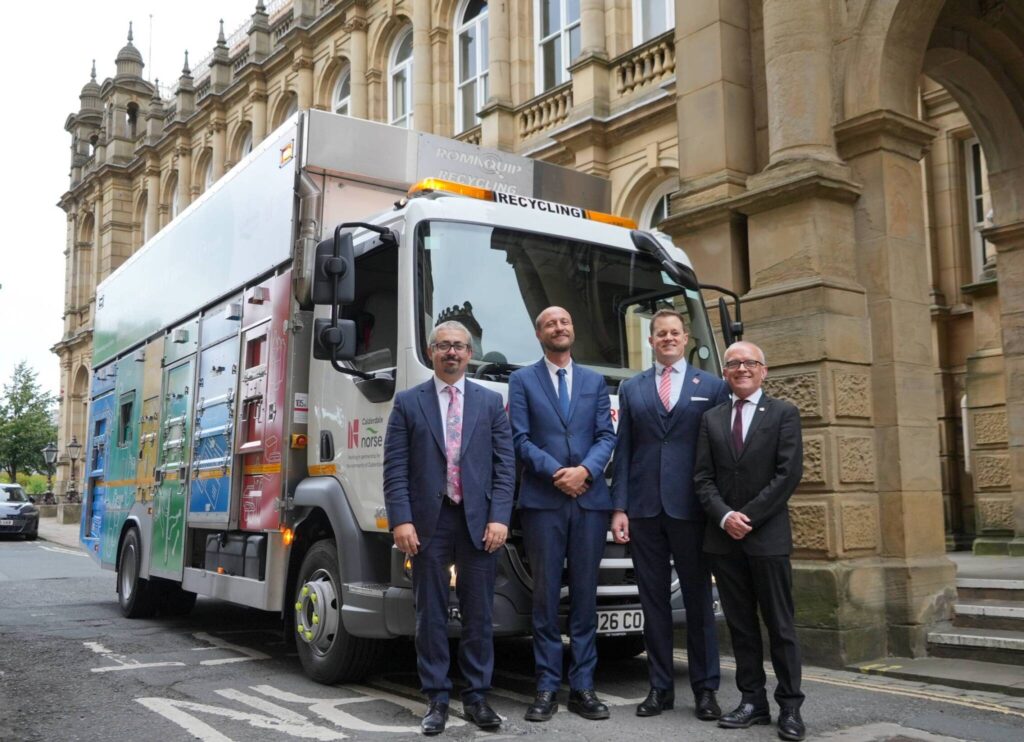






James Hendry, Assistant Director at Basildon Council, speaks to LAPV about the challenges and lessons learned from rolling out the UK’s first fully electric food waste collection service.
What were the key operational and technical challenges of deploying the UK’s first fully electric food waste collection service, and how did you overcome them — particularly around vehicle range, payload capacity and round planning?
Our waste strategy was out of date, so we started work on a cross-party basis in 2018, developing a new strategy in 2019 aligned to the council’s net zero ambitions — by 2030 as a council and 2050 as a borough. Waste services are a significant contributor to a council’s carbon footprint: a lot of vehicles, a lot of diesel, a lot of miles on the road every year.
We’re a reasonable-sized authority — around 78,000 homes and 170,000 people — and we were coming from quite a low base in terms of recycling performance, with our recycling rate dropping around 1% year on year. We knew we weren’t going to be compliant with the changes brought in by the Environment Act, so we had to decide whether to act now or wait to be forced into it. The ambition of the authority was to reduce our carbon footprint and modernise the service, so we got on with it.
A waste composition analysis identified food waste as a key material we weren’t capturing effectively. We were running a mixed garden and food waste collection, but capture rates weren’t clear, and we knew a lot of food waste was going into the residual stream. That became our first key target material.
We looked at what other authorities had done, ran trials to assess participation rates and payloads, and worked with WRAP. We trialled providing liners and not providing them to see what that did to participation. All of that led to a full-scale options paper, developed with NRG Riverside and our chosen EV chassis provider Electra Commercial Vehicles. We concluded that 7.5-tonne vehicles would be too small given our geography and expected participation rates, and we looked at the different vehicle options available, including electric.
For round planning, we worked with Route Smart software, but crucially we did that in dialogue with our staff. The software gets you most of the way there, but you need that conversation with the people doing the job. We also made sure there was regular feedback and data uploads from the vehicles on performance, which helped us identify issues early and feed them back to NRG Riverside for software adjustments. By changing the vehicle software, you can change range and battery usage — and managing driver style is also a big part of it. It’s a slightly different type of driving, and keeping drivers in the conversation throughout was really important.
How did you work with NRG Riverside and vehicle manufacturers to specify and procure the right electric vehicles, and what would you do differently with the benefit of hindsight?
We came to it with a clear brief: here’s what we’ve learned from other authorities, here’s what we know works and what doesn’t, here’s what we need, and here are the contingencies. We work in partnership with NRG Riverside, so we got into a room together and worked through how our fleet needed to meet the demands of the service. At the end of the day, residents don’t care what badge is on the vehicle — they just want the service to run. So what I need is a partner that understands I just want the vehicles to work.
We went with reliable bodywork and good drivetrain components throughout. NRG and Electra kept us updated throughout the build process. There was a slight lag in delivery, but that was managed — they understood that the service had to start on a specific date. We’d already communicated to residents, recruited staff, and distributed containers. I couldn’t turn around and tell people the service was being delayed by four weeks. They understood what was at stake and delivered accordingly, including demoing the vehicles, onboarding and training staff as they came online.
In hindsight, the main issue was with the chargers. The initial charging units had a reliability problem — there was a communication issue between the charger and the vehicle, and it meant vehicles weren’t charging overnight as expected. Drivers were coming in to find vehicles without enough charge to complete their rounds, which was a real problem. We had engineers out several times and ultimately replaced some of the charging units. That was manageable, but it underlined the importance of having that direct line of communication with your drivers. They’re the ones using the vehicles every day and they’ll tell you quickly what’s working and what isn’t. We’d approached NRG and selected Electra from the outset and said: we’re going to be your guinea pigs, but that means we need to work together when things need changing. They were receptive to that and we all went in with eyes open.
Food waste vehicles have specific demands — frequent stopping, heavy kerb-side lifts, potential odour and hygiene issues. How have the electric vehicles performed against their diesel predecessors in day-to-day operational terms?
Now that the charger issues are sorted, I’m getting very few problems. The service is performing well, participation rates are good and yields are good. We did see quite a spike in materials initially, which has since dropped back by around 10% — but interestingly, that material hasn’t gone back into the residual waste stream either. It’s simply disappeared from the waste stream altogether, which suggests people are changing their behaviour. If you realise you’re throwing out half a loaf of bread every week, you start thinking differently about it. That’s far more sustainable than collecting the material in the first place — prevention is better than cure.

Electra food waste truck © Electra
We’re now a couple of years into the service and the vehicles are still out there every day. We’ve run through several cycles of winters and summers, so we’ve had to manage the impact of heating and air conditioning on range. Working with drivers to overcome range anxiety — giving them confidence in what the vehicles can do — has been a really positive part of the process. Vehicle familiarisation matters: driving an EV is a different experience and many of our drivers hadn’t done it in their personal lives either.
One thing we’ve committed to is a long-term total cost study once we have sufficient data — looking at the full unit cost of the vehicles over time, including charging costs. With fuel price volatility being what it is, being able to lock in overnight charging tariffs is a significant advantage. We know that compared to diesel there’s a meaningful reduction in CO2 year on year, but I want to be able to demonstrate the full financial picture as well.
What has the impact been on depot infrastructure and charging strategy, and what advice would you give to other councils considering the same transition?
My main piece of advice is to speak to your local distribution network operator — in our case UKPN — early. Their teams are busy and they plan infrastructure works well in advance. Look at your site carefully and understand what you can get in before you commit to anything.
At our current depot, we’re at the maximum power we can bring onto the site. Going any further would require around £350,000 of investment just to get to the next level, plus a couple of years of work. That means I can’t add any further EVs to my fleet at the current location. My parks vehicles, supervisor vehicles and recycling teams have all moved to full EVs, and my food waste fleet is fully electric, but I’m not looking at larger 26-tonne vehicles at the moment for that reason.
We were also coordinating a lot of moving parts simultaneously — rolling out a new service, installing chargers, getting the electric vehicles delivered on time, and coordinating UKPN’s work to uprate the power supply to the depot. Having a very good project manager was essential. The fear is that you go into this with lofty ambitions — first electric food waste service in the country — and then the vehicles aren’t there to collect from people’s households. You’d lose that opportunity entirely. Getting all of those interlocking pieces to come together on time was genuinely nerve-wracking.
Looking further ahead, we’re aware that Essex is on the devolution priority pathway and local government reorganisation is on the horizon. A larger combined authority brings scale, and with that comes the opportunity to think differently about fleet strategy — potentially standardising on electric up to 12.5 tonnes, looking at HVO for larger vehicles, and considering sub-depots. There’s real scope to do something significant at that scale.
The service sits alongside a wider digital transformation that has cut missed collections and saved over £200,000. How do the in-cab technology and electric fleet elements complement each other, and is full electrification of the wider waste fleet now on the roadmap?
Full electrification is something I’d love to pursue, but I can’t do it at our current site — the infrastructure simply can’t support it. That conversation will form part of our planning ahead of 2028 and any reorganisation.
On the digital side, the in-cab technology came directly out of conversations with our collection crews. They were flagging the same problems week in, week out and asking what we could do to support them in the field. That’s where the software was designed from. The whole point is that no matter who’s on a given route, they have access to all the information they need. It’s moved the service away from being an individualistic operation and made it a team effort. Supervisors can see where crews are, allocate workload more effectively, and respond quickly when things go wrong.
We’ve also seen a healthy competitive element emerge between crews — drivers comparing missed collection rates, wanting to be top of the pecking order. That kind of friendly competition has been really positive. And crucially, we’ve been able to improve outcomes and save money without reducing headcount, which is often the default assumption with this kind of change. Residents are experiencing a better service and staff feel more supported.
Missed collections are now cleared in under one working day on average, compared to four or five previously. That’s a real, tangible improvement for residents.
We also ran a competition with local schools and staff to name the vehicles, which generated some brilliant suggestions — Vin no Diesel and Dustbin Bieber among them. The crews picked the winners and the names went on the liveries alongside our climate change branding. It gave us a reason to take the vehicles into schools, do the communications and education work, and get the community involved. It’s been a really good project from start to finish.
Enjoyed this interview? Stay connected with LAPV — sign up to our free weekly newsletter for the latest fleet and plant news delivered straight to your inbox, and request your free quarterly copy of LAPV Magazine in print or digital. Visit lapv.co.uk to subscribe and sign up today.
Leave a Reply