
















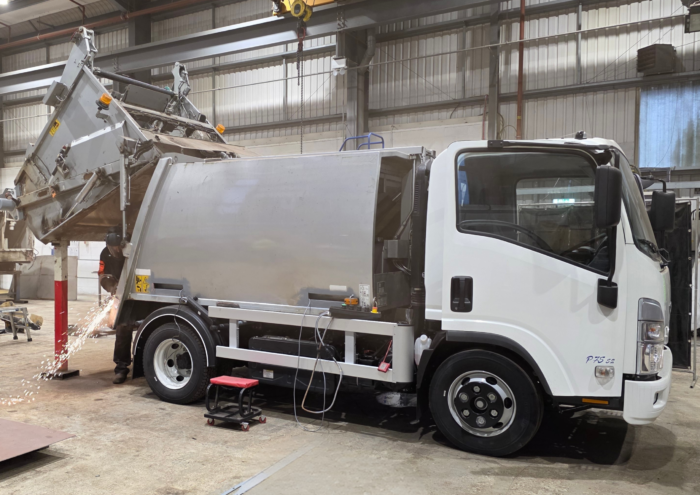
Refuse vehicle manufacturer NTM-GB has completed a major refurbishment of one of its own 15-year-old K-Midi refuse collection vehicles (RCV), restoring the veteran rear-loader for a customer in Europe. LAPV reports.
The vehicle, originally manufactured in 2011, was commissioned for the refurbishment work in January after a decade and a half spent on public waste collection duties. By that point, the RCV was showing the wear expected after such an extended period of service, with its bodywork and mechanical components reflecting years of daily use on collection rounds.
The work was carried out by NTM-GB’s Aftersales Refurbishment team, who took on the project with the aim of restoring both the appearance and performance of the vehicle. Rather than replacing the RCV outright, the company opted for a full refurbishment, an approach it says extended the vehicle’s working life while saving the customer time, money and resources compared with buying new.
Aftersales Manager David Parsons said the team had set out to give a vehicle nearing retirement a new lease of life, and that the finished result performed like a more recent model. He described the outcome as ‘a powerful testament to the durability and longevity of NTM RCVs.’
According to NTM-GB, the customer was pleased with the results, and the project demonstrates that with the right expertise, older RCVs can continue operating safely and effectively well beyond what might typically be expected of a vehicle of that age. The company also points to an environmental benefit, noting that refurbishing existing vehicles rather than replacing them reduces the resources needed to keep waste collection fleets running.
The refurbishment forms part of NTM-GB’s wider aftersales offering, through which the company supports operators looking to extend the working life of their existing fleets rather than committing to costly replacements, an approach it says can deliver both economic and environmental benefits for customers managing ageing vehicles.
NTM-GB is the UK arm of NTM, a refuse vehicle manufacturer with origins dating back to 1950, when the business was founded in Finland. The company designs and manufactures customised refuse collection vehicles and holds both ISO 9001 and ISO 14001 certifications. NTM-GB itself was established in 2003 as a UK subsidiary, initially based in Willenhall in the West Midlands, before expanding through the acquisition of polybody specialist Link-Tip in 2011 and relocating to a larger manufacturing site in Kidderminster in 2015. The wider NTM Group reports annual revenue of around €140m, employs more than 700 people, and operates over 100 service centres and 16 sales points across different countries.
The company’s aftersales network, which underpins projects such as this refurbishment, is supported by service agents across the UK, allowing it to offer what it describes as full life-cycle care for vehicles long after they leave the factory. That infrastructure is central to NTM-GB’s case for refurbishment over replacement: rather than treating an RCV’s first life as its only life, the company positions its Aftersales Refurbishment team as a route back to near-new performance for vehicles that might otherwise be scrapped or sold on at reduced value.
For operators, the appeal is largely financial. Refuse collection vehicles represent a significant capital outlay, and extending the working life of an existing fleet by several years can defer that cost considerably. NTM-GB argues that, with the right combination of mechanical overhaul and bodywork restoration, even vehicles well past the decade mark can be returned to a standard comparable with newer models.
The environmental case follows a similar logic. Manufacturing a new RCV requires raw materials, energy and transport, all of which carry an associated carbon cost. By contrast, refurbishing an existing chassis and body reuses much of that embedded value, reducing the resources needed to keep a waste collection fleet on the road.
For local authorities and private operators alike, who face mounting pressure to demonstrate sustainability credentials alongside value for money, this combination of cost savings and reduced environmental impact may help explain why refurbishment is becoming a more visible part of the wider refuse vehicle market, rather than a niche alternative to new purchases.
Photo: The 15-year-old K-Midi refuse collection vehicle © NTM-GB
Leave a Reply