
















BCP Council’s experience with JCB’s 1TE Site Dumper from the E-TECH range shows how electric plant can deliver diesel-level performance while supporting net zero goals in sensitive public spaces. LAPV reports.
For local authorities balancing operational performance with ambitious environmental targets, the shift to electric plant is no longer a future ambition—it is happening now. At BCP Council, that transition is already delivering tangible results, with JCB’s E-TECH range proving that zero-emissions machinery can match the demands of frontline services.
Responsible for eight cemeteries across the south coast, BCP Council operates in environments where sensitivity, precision and public experience are paramount. For Simon Woodall, Team Operations Manager, finding equipment that could meet both operational and environmental needs was critical.
‘The performance and reliability of the machine in general use is equivalent to a diesel,’ he explains. ‘It performs every task we ask of it and, reliability-wise, it’s exactly what we’d expect.’
That reassurance is key for fleet and operations managers considering electric alternatives. Concerns around power, durability and usability remain common—but BCP’s experience suggests those barriers are rapidly diminishing.
A week-long demonstration allowed the team to fully evaluate the machine in real-world conditions before specifying their own configuration. Practical additions such as less aggressive turf tyres, LED work lights and an amber beacon ensured the machine was tailored to its working environment from day one. Full training on installation further supported a smooth transition for operators.
For frontline staff, usability and safety are just as important as performance. At Bournemouth Crematorium, Supervisor Paul Abraham highlights the intuitive—but safety-focused—operation of the electric machine.
‘There is a procedure when you start it—everything in neutral, foot on the brake. It’s something you get used to, but ultimately it’s a safety feature that’s warranted,’ he says.
Charging is equally straightforward. Using a standard three-pin mains supply, the machine can be plugged in and left to charge overnight, ready for the next working day. In practice, the team achieves around four hours of continuous use – more than enough to meet daily operational demands in this setting.
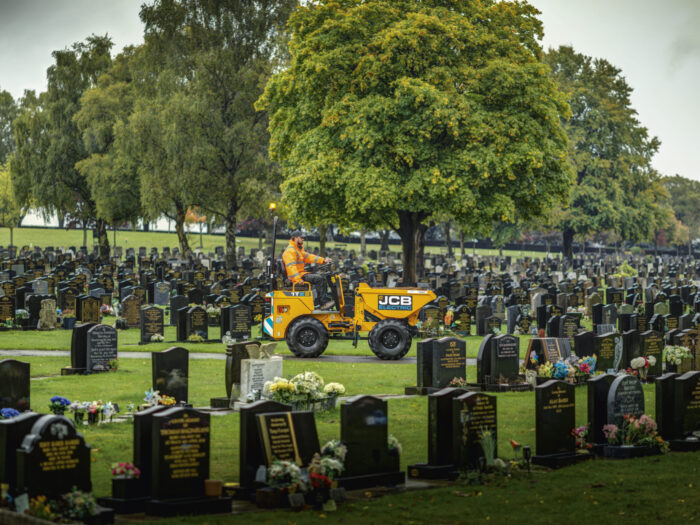
Beyond performance, it is the operational advantages of electric plant that are making the biggest impact. The near-silent running of the battery-powered machine is particularly valuable in cemeteries and bereavement spaces, where noise can be intrusive and inappropriate.
‘The fact it’s silent really lends itself to this environment,’ Woodall notes.
Manoeuvrability is another key benefit. With tight steering and a compact footprint, the machine is well suited to confined areas, allowing operators to access difficult spaces with ease. This flexibility is essential for teams working across varied and often restricted sites.
Maintenance and fleet management are also streamlined. BCP Council carries out servicing in-house and benefits from a 500-hour service interval, reducing downtime and ongoing maintenance requirements. Meanwhile, JCB’s LiveLink telematics system provides weekly usage summaries directly to managers’ inboxes, supporting data-driven decision making and improved asset utilisation.
BCP Council’s move towards electric plant forms part of a wider strategy. Since declaring a climate emergency in 2019, the authority has committed to reducing emissions across its operations, including the adoption of electric vehicles and plant.
‘We already have a large number of electric vehicles within our fleet and are now looking at battery-powered alternatives for plant,’ Woodall explains. ‘We’ve also recently trialled an electric excavator, which our team responded to very positively.’
This broader transition is supported by a longstanding relationship with local dealer Holt JCB, as well as confidence in JCB’s continued investment in electric technology.
For councils nationwide, the implications are clear. JCB’s E-TECH range is designed to deliver diesel-equivalent performance with zero emissions at point of use and significantly reduced noise levels. As local authorities work towards net zero targets, solutions that combine sustainability with operational effectiveness are essential.
BCP Council’s experience demonstrates that electric plant is not just a viable alternative—it is a practical, proven solution. With quiet operation, reduced emissions and no compromise on performance, the next generation of council fleets is already taking shape.
Photo: JCB’s 1TE Site Dumper from the E-TECH range © JCB
Leave a Reply