













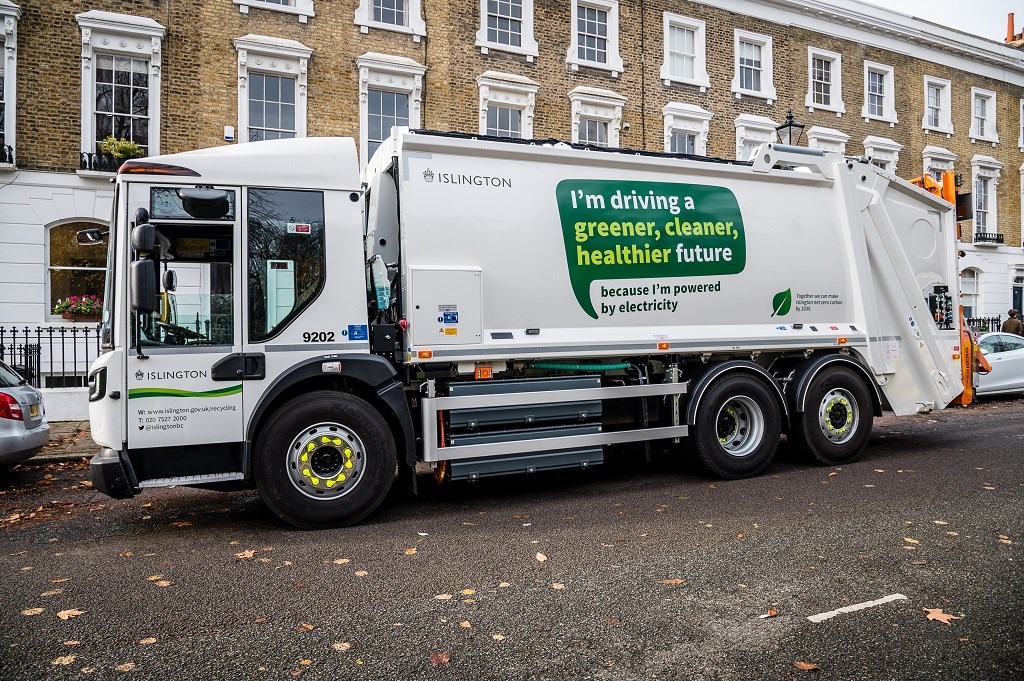



Chris Demetriou, Assistant Director of Corporate Fleet, Transport & Accessible Community Transport at Islington Council, discusses fleet decarbonisation, AI and smart energy management with LAPV.
1. What are the biggest practical and financial challenges in fully decarbonising council fleets, and how can councils realistically overcome them?
Decarbonising local authority council fleets is increasingly complex, yet our experience in Islington demonstrates that it remains both achievable and financially viable. While the core practical challenges; particularly the cost and scale of charging infrastructure continue, the market for electric vehicles suitable for local authority operations has expanded significantly in recent years. Our fleet now includes electric cars, vans, cage tippers, sweepers, buses, both new and upcycled refuse collection vehicles (RCVs), food waste vehicles, and a bespoke youth services van, illustrating that full electrification across vehicle types is now realistic. Work is ongoing to transition more specialist vehicles, such as our skip and gully vehicles too.
Financial pressures, including the rising cost of living and increased SEND expenditure across councils, have tightened budgets and made upfront investment in vehicles, infrastructure, and staff training much more difficult. To address this, we have reframed energy as a managed commodity, enabling more strategic investment in green technology. Our early adoption proved beneficial; receiving £1.5m from the Greater London Authority’s Good Growth Fund in 2019 which allowed us to upgrade our high‑voltage substation and install a range of AC and DC chargers at our main depot.
We are also expanding our electric vehicle (EV) infrastructure sharing initiative at the Waste & Recycling depot, which now supports both council and commercial fleets, including Islington’s Metropolitan Police. Alongside this, we are piloting vehicle‑to‑grid technology to enable our EVs to function as both operational assets and portable energy storage, with the potential to sell energy back to the grid during peak periods in the future. Larger battery vehicles such as buses and RCVs offer particular opportunities as ‘energy on wheels.’
A phased transition to electrification, supported by private‑sector partnerships and Government grants, can reduce financial risk. Public engagement and education remain essential to securing wider acceptance of EV’s and as local authorities we should be at the forefront of driving this change. Through innovation and a strategic approach to energy management, local authorities can continue progressing toward net zero despite challenging economic conditions.
2. How should local authorities approach charging infrastructure planning to balance operational fleet needs with wider public EV demand, especially in dense urban boroughs like Islington?
A strategic, integrated approach is essential. In Islington, we have upgraded our main depot with approximately 140 charging points including AC, rapid, and ultra‑rapid chargers to support our fleet vehicles and, increasingly, commercial fleets that may lack the resources to install their own infrastructure. This shared use model is being piloted with partners such as the Metropolitan Police, with further collaboration planned through Cenex and Transport for London (TfL). We are also exploring revenue opportunities by offering charging services to external fleets.
Our on‑street public charging network has grown to more than 600 charge points, with a target of 800 by 2026, supported by £1.86m in Government LEVI funding. Charging infrastructure planning is guided by data driven analysis, using real‑time information on EV usage, traffic patterns, and network performance to ensure optimal charger placement.
For staff who take vehicles home, we are piloting home charging solutions and an energy reimbursement scheme for work‑related charging. However, as not all drivers have access to off‑street parking; particularly those living outside the borough, bespoke solutions are required. Many of these staff operate vans, making reliable charging essential to avoid operational disruption. To address this, we are exploring destination and opportunity charging, along with innovative options such as mobile charging units at work sites where vehicles remain parked for extended periods.
Collaboration with stakeholders, smart demand management technology, and multi‑use charging facilities are crucial to maximising efficiency and minimising cost. This integrated approach will enable local authorities to meet operational requirements while supporting wider public EV demand, even in dense urban environments like Islington.
3. How are telematics, AI, and fleet data analytics shaping decision-making in council fleet operations, and what role will data play in improving efficiency and reducing emissions?
Telematics, AI, and data analytics are already integral to our fleet strategy in Islington and will become increasingly embedded in future operations. We maintain comprehensive operational data across multiple systems, supporting both real‑time monitoring and strategic decision making of all our fleet vehicles.
Our telematics and fleet management platforms provide live vehicle tracking, driver‑behaviour insights, maintenance scheduling, and charging optimisation. This data‑driven approach has reduced vehicle related incidents, cut fuel and energy use by 25%, and delivered annual operating savings of £150,000 to £200,000 so far, alongside substantial carbon reductions. The data also helps identify both under and overused utilised fleet vehicles. This enables us to balance workloads more effectively and reduce the overall fleet size where appropriate. In some cases, this has included shifting certain work functions to alternative modes of transport such as e‑bikes and e‑cargo bikes.
Different vehicle types present distinct challenges with driver behaviour given a greater priority for vans, whereas safety critical issues are more prominent for refuse vehicles and buses. Innovations such as enhanced safety systems, monitoring for bin hopper related risks, and managing lithium‑ion battery fire hazards are becoming increasingly important and we are trialling AI solutions for all of these dangers.
Enhanced Advanced Driver Assistance Systems (ADAS), predictive vehicle maintenance, and behavioural analytics are crucial for improving safety and reducing emissions all powered by improved AI. These advancements will not only benefit local authority fleets but of course all fleet operators, promoting greater efficiency and reducing emissions.
4. With ongoing budget constraints in local government, how can fleet managers make the business case for investing in low- and zero-emission vehicles while maintaining essential frontline services?
The business case for electric vehicles is driven primarily by longer term cost savings, particularly for larger assets such as refuse collection vehicles (RCVs) and buses, alongside wider non‑financial benefits such as reduced emissions and improved public health for our residents and for our staff.
Although upfront costs are higher for the larger assets in particular, our analysis shows that electricity at 30–40p/kWh remains significantly cheaper than diesel at £1.10–£1.30 per litre. For example, a diesel RCV costs approximately £25,000 per year in fuel, compared with around £4,000 for an electric equivalent. Maintenance costs are also substantially lower, especially for vehicles in daily operation.
Vehicle reliability is essential for frontline services, and electric RCVs and buses must consistently meet operational requirements. Any downtime leads to staff frustration and additional costs, including overtime or short‑term vehicle hire. Energy management is also a critical component of the business case for EVs. Robust, well‑managed charging infrastructure and a dependable power supply are fundamental to ensuring vehicle availability, maintaining service continuity, and supporting future innovations such as infrastructure‑sharing models and vehicle‑to‑grid technology.
Our upcycling programme for near‑end‑of‑life diesel RCVs delivers an 80% reduction in embedded carbon and saves around £100,000 per vehicle compared with buying new assets. Drivers also favour the upcycled vehicles due to their familiarity with the cab and operating systems, supporting smooth operational transition.
We align investment proposals with wider sustainability objectives and use telematics data to evidence emissions reductions. Flexible funding models including partnerships, grants, and where appropriate leasing help mitigate financial pressures. Additional benefits such as improved air quality, reduced noise, and associated public‑health gains further strengthen the case for transitioning to low- and zero-emission fleets.
5. In the context of accessible community transport, how do you see fleet innovation improving mobility for vulnerable residents, and what should councils prioritise to ensure inclusive transport remains sustainable and resilient?
Fleet innovation plays a critical role in improving mobility for our most vulnerable residents. Our Accessible Community Transport service operates a fleet of accessible minibuses and specialist vehicles that support vulnerable and elderly adults as well as SEND children. We have invested in new electric accessible vehicles, and we will be transitioning to a web‑based management system to enhance planning and integration with our social care partners.
We are also developing co‑designed accessible buses, working closely with drivers, passenger assistants, colleagues, sensory specialists, and service users. The needs of a five‑year‑old SEND child, a fifteen‑year‑old pupil, and an elderly wheelchair user differ significantly, and each upcycled vehicle will be tailored accordingly to provide a safer and more positive user experience. Our ongoing user engagement, continued investment in our accessible vehicle fleet, and digital platforms that support real‑time travel information are essential to ensuring our services remain inclusive, sustainable, efficient and resilient.
6. With innovations like Simpler Recycling improving household food waste collection, how do you see local authority fleets adapting to support circular economy initiatives, and what operational or logistical changes are needed to make these schemes more efficient and sustainable?
We have been expanding food‑waste services for several years, and all housing estates including those not owned by the council now have dedicated food‑waste bins. Our current priority is extending this provision to all flats above shops, supported by communal pavement level bins and DEFRA funding for new specialist food‑waste vehicles and infrastructure. Our new electric food‑waste vehicles are equipped with bin‑weighing systems and telematics, and we are trialling smart bins and optimised routing to enhance efficiency and reduce environmental impact.
Our Circular Economy Action Plan includes repair cafés, reuse networks, and a ‘library of things,’ all aimed at reducing waste, increasing recycling to 40% by 2030, and strengthening community engagement. These initiatives have already received national recognition and are saving up to £1.6m per year in disposal costs.
Photo: Chris Demetriou, Assistant Director of Corporate Fleet, Transport & Accessible Community Transport at Islington Council © Islington Council
Leave a Reply